Mehmet Hakkı Suçin
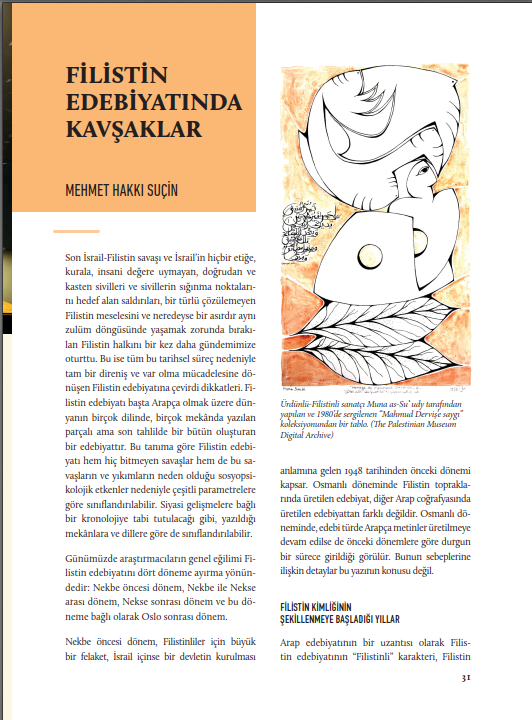
The latest Israeli-Palestinian war, and Israel’s attacks, which respect no ethics, rule or human value and deliberately and directly target civilians and their places of refuge, have once again put on our agenda the Palestinian question that has never been resolved, and the Palestinian people who have been forced to live in the same cycle of oppression for almost a century. This has turned attention to Palestinian literature, which, because of this whole historical process, has become a struggle of resistance and existence. Palestinian literature is a fragmented literature, written in many languages of the world – above all Arabic – and in many places, yet in the final analysis it forms a whole. By this definition, Palestinian literature can be classified according to various parameters, owing both to the never-ending wars and to the socio-psychological factors caused by these wars and this destruction. It can be arranged in a chronology tied to political developments, or classified according to the places where, and the languages in which, it was written.
Researchers today generally divide Palestinian literature into four periods: the pre-Nakba period, the period between the Nakba and the Naksa, the post-Naksa period and, following from it, the post-Oslo period.
The pre-Nakba period covers the time before 1948, the year that meant a great catastrophe for the Palestinians and the founding of a state for Israel. The literature produced in Palestine during the Ottoman period did not differ from that produced in the rest of the Arab world. Although Arabic texts in literary genres continued to be produced in the Ottoman period, there was a stagnation compared with earlier periods. The reasons for this are not the subject of this essay.
The years when Palestinian identity began to take shape
As an extension of Arabic literature, the “Palestinian” character of Palestinian literature began to take shape in parallel with Palestinian identity and belonging. With the Balfour Declaration of 1917, issued by the British just before their occupation of Ottoman-ruled Palestine, a homeland for the Jews was promised in Palestine. Immediately afterwards, with increasing Jewish immigration to Palestine after the First World War, a strong “other”, backed by the British, began to emerge in social life. This process strengthened Palestinian identity in the modern sense. The Palestinians now had more than one adversary to struggle against: the British Mandate administration, the collaborating landlords who sided with it, and the Jewish immigrants who, with the kibbutzim they founded, increasingly threatened the Palestinian peasantry. In this respect the Palestinian struggle can also be said to have had a class character.
Palestinian literature in this period was under the influence of two currents. The first was the neoclassical line in poetry, represented in Egypt by poets such as Mahmud Sami al-Barudi and Ahmad Shawqi, which consisted of the effort to write modern poetry with the resources of classical Arabic poetry. The second was that of the Mahjar poets and writers who had emigrated from Lebanon to North and South America from the late nineteenth century onwards, above all Kahlil Gibran, Mikhail Naimy and Elia Abu Madi. Although we can see an as yet unnamed romanticism in classical poets such as al-Mutanabbi, it was the Mahjar writers who first introduced Arabic literature to romanticism in the Western sense.
Among the leading poets of the period are Is’af al-Nashashibi, Ibrahim Tuqan, Mutlaq Abd al-Khaliq, Abd al-Rahim Mahmud and Abd al-Karim al-Karmi, known as Abu Salma. Of these, al-Nashashibi wrote neoclassical poetry close to Ahmad Shawqi’s style, but showed his real achievement in classical-style prose. Mutlaq Abd al-Khaliq wrote poems in the style of the American Mahjar poets known as “whispered poetry”; a pessimistic mood prevails in his poems on the theme of death. In the late 1930s Abd al-Rahim Mahmud wrote fiery poems warning the people of the region against the dangers awaiting Palestine; he was among the writers killed in the 1948 war. Abd al-Karim al-Karmi, alias Abu Salma, continued to carry Palestine’s suffering into his poetry while in exile in Damascus.
Another notable poet of the period, Ibrahim Tuqan, was the elder brother of Fadwa Tuqan, who would later become one of the major poets of Palestinian poetry. He studied at the American University of Beirut and took part in the city’s cultural and literary life. Although he wrote in the neoclassical style, an ironic air prevails in his poems, often turning into black humour. Ibrahim Tuqan, who worked as a teacher, wrote this parody of a poem by the Egyptian Ahmad Shawqi:

شوقي يقول وما درى بمصيبتي قم للمعلم وفّه التبجيلا
اقعد فديتك هل يكون مبجلاً من كان للنشء الصغار خليلا
ويكاد يقلقني الأمير بقوله كاد المعلم أن يكون رسولا
لو جرّب التعليم شوقي ساعة لقضى الحياة شقاوة وخمولا
(Shawqi says, not knowing my plight:
“Rise for the teacher and pay him full reverence.”
Sit down, may I be your ransom! Can one be revered
who has become the companion of little children?
And the Prince of Poets almost unsettles me when he says:
“The teacher was almost a messenger.”
Had Shawqi tried teaching for a single hour,
he would have spent his life in misery and torpor. — Ibrahim Tuqan; Arabic text: al-Diwan; translated from the Arabic for this site)
In this period, along with the development of Palestinian identity, a literature with a Palestinian character took clear shape. In response to the “imported” kibbutz culture that appeared in Palestine, clothing specific to the Palestinian peasant (the keffiyeh, the embroidered dress) became the symbol of Palestinianness. As the Israeli historian Ilan Pappé has noted, “In trying to create the Israeli nation, the Zionist movement created two nations: the Palestinians and the Israelis.” For a broader analysis of how Palestinian identity was formed and of the socio-cultural and socio-psychological reasons behind it, one may consult Erhan Keleşoğlu’s book İsrail Yurttaşı Filistinliler (Palestinian Citizens of Israel).
As Keleşoğlu notes in his book, on the eve of the founding of the State of Israel in a large part of Palestine in 1948, nearly two million people lived in Palestine under the British Mandate, a third of whom were Jews. As a result of the ethnic cleansing and mass flight that Israel carried out at the end of the war, about 10% of the Palestinian Arab population (160,000 people) remained within Israel’s borders, while 780,000 Palestinians became refugees in the West Bank, which came under Jordanian control during the war, and the Gaza Strip, which came under Egyptian control.
In the Nakba of 1948 the Palestinians lost everything, including their homes. This is the most important breaking point for Palestinian literature and identity. The Palestinian people, essentially an agrarian society, were mostly peasants and workers. The peasants’ severance from the land to which they felt they belonged made the land and the return home national symbols. Throughout this process Israel’s discourse was: “There is no such thing as a Palestinian people; they are refugee Arabs or Arabs living in Israel.” It was in such an environment that the Palestinians tried, and still try, to preserve their identity.
The breaking of traditional form in Palestine
After the catastrophe of 1948, Palestinian literature entered an important crossroads. Following the efforts at “renewal in Arabic poetry” launched in Iraq in the 1950s by Nazik al-Malaika and Badr Shakir al-Sayyab, the trauma of the Nakba in Palestine brought the idea of breaking traditional form in poetry. The time had come to break poetic forms that had persisted since pre-Islamic times. In these years Palestinian poetry too witnessed bold and successful formal experiments, from free verse (tafʿila poetry) to the prose poem (qasidat al-nathr). At the level of meaning, the tragedy of 1948 gave poetry new dimensions in terms of themes and situations. The social and political context of poetry in particular found an echo in the Arab world.
The innovations in poetic creativity of the 1950s, the serious attention paid to aesthetics, the continuous development in narrative and theatre, and the intense debates in theory accelerated in the second half of the twentieth century.
The great exodus of people from Palestine with the catastrophe of 1948 (the Nakba) exposed the poets and writers forced to live in exile to more new influences than the writers who remained in Palestine. The Palestinian writers who remained inside Israel went through a period of great bewilderment after 1948 and took time to find themselves again. The Palestinian writers in the diaspora, by contrast, overcame the first shock by the mid-1950s and continued their activities with vitality and determination; some of them were even at the forefront of creativity in the short story and poetry.
In this period, while Abd al-Karim al-Karmi (Abu Salma) recited “loud-voiced” poems before large crowds, Fadwa Tuqan developed her own mode of expression, a woman’s voice. She showed an extraordinary talent for expressing the joy of the liberation of soul and body. Over time this talent of Tuqan’s evolved into a poetry of resistance, and she became one of the strong voices defending her people and their rights before large crowds. Fadwa Tuqan is among the revolutionary women poets who became symbols of the Palestinian struggle; with her poems and her struggle she gave life to the Palestinian cause. Mahmoud Darwish called her “the mother of Palestinian poetry”.
For many years after the Nakba, the Palestinian poets and writers in Israel were deprived of contact with their displaced compatriots. After a while, however, the poems of Tawfiq Zayyad, Mahmoud Darwish and Samih al-Qasim began to reach Arab readers. Welcomed with great joy in the 1960s, these names became known throughout the Arab world over the years. One of them, Mahmoud Darwish, left Israel in the early 1970s and became one of the foremost Arab poets of the modern age and of the whole history of Arabic poetry.

Among the diaspora poets who contributed to the poetic revolution of the 1950s, Tawfiq Sayigh and Jabra Ibrahim Jabra stand out. Besides his interest in literary criticism, Jabra turned to the short story at an early age; he later became one of the major novelists of the Arab world.
As a poet, Jabra was among the first to introduce the prose poem into Arabic literature and to use fertility myths in Arabic poetry. By translating the part of Frazer’s The Golden Bough dealing with the myths of Adonis or Tammuz, he helped Arab poets become acquainted with these myths. The influence of T. S. Eliot on the poets of this period should not be forgotten either. The use of these myths, which tell of a god who rises again and brings fertility and life to the world, reflects a deep hope that the Arab spirit would rise again after the catastrophe of 1948.
Tawfiq Sayigh was the first Palestinian poet to establish, from the 1950s onwards, the modernist current that was still in its infancy in Arabic literature. His first avant-garde prose-poetry work was his Muʿallaqa, written in 1936. This modernist opening of his was noticed only with his book Thalathun Qasida (Thirty Poems), published in 1953.
Examples from the Palestinian short story and novel
The first examples of the Palestinian short story and novel in the Western sense appeared in this period. Earlier, one can also find texts in a style resembling the classical Arabic narrative genre of the maqama and allegorical tales.
As translations into Arabic appeared in the press, familiarity with this genre grew. Among the writers who stood out in modern-style fiction, in addition to Jabra Ibrahim Jabra, were Khalil Baydas, Ahmad Shakir al-Karmi, Jamil al-Bahri, Ishaq Musa al-Husseini, Mahmud Sayf al-Din al-Irani and Samira Azzam.
Of these, Khalil Baydas was an important intellectual figure. A graduate of the Russian Orthodox school in Nazareth, he translated from Russian literature and at times translated into Arabic books that had been translated from Western languages into Russian; his translations of Victor Hugo were made via Russian. Baydas regarded fiction as the best means both of educating people and of entertaining them aesthetically. Having published a novel, al-Warith (The Heir), and a collection of stories, Baydas can be considered the father of the Palestinian short story.
In Khalil Baydas’s novel The Heir, a young Syrian man goes to Egypt on business and there loses his heart to a Jewish dancer. In collusion with some Arabs, the woman strips him of everything and leaves him in debt. With this novel Baydas seems to draw attention to Jewish ambitions concerning Palestine.
Ahmad Shakir al-Karmi also knew English well. He translated writers such as Oscar Wilde and Mark Twain into Arabic, and rendered writers such as Maupassant, Tolstoy and Chekhov into Arabic via English. Jamil al-Bahri liked translating detective stories and dramatised many stories and novels.
Baydas, al-Karmi and al-Bahri each published a journal. Both translated and original texts appeared in these journals, which also gave importance to texts on poetry and literary theory.
In his novel Mudhakkirat Dajaja (Memoirs of a Hen), Ishaq Musa al-Husseini creates an animal world similar to that of Kalila wa Dimna. The hero of the novel, a hen, moves to a new country to live a peaceful life, but soon giants raid the country, burning and destroying everything in their path and forcing all its citizens to emigrate. The hen strives to call this angry community to reason.
After the catastrophe of 1948, in the 1950s Palestinian narrative art, in parallel with developments in the Arab world in general, focused mostly on the short story or the novella. Four short story writers, all living in exile outside Palestine, stood out in this period: Mahmud Sayf al-Din al-Irani, Jabra Ibrahim Jabra, Samira Azzam and Ghassan Kanafani.
Mahmud Sayf al-Din al-Irani was born in Jaffa and knew English, French and Persian well. He built his stories on plain and realistic plots. Although some of his stories are weakened at times by his moralising tendency, he wrote sounder texts than earlier attempts at the short story. His collection Maʿa al-Nas (With People) is foremost among the books that best reflect his skill.
Born in Bethlehem, Jabra Ibrahim Jabra studied English literature in England. He became a Muslim in order to marry Lamia, an Iraqi woman. He published 12 novels, 4 books of poetry, 12 translations and 15 studies. He carried the Arabic short story to a more modern level. Moreover, he included in his narratives issues that society would find hard to bear: in one of his narratives, when the men of a city become impotent, the women turn to lesbian relationships. The writer’s attitude changed, however, once he became concerned with questions of thought.
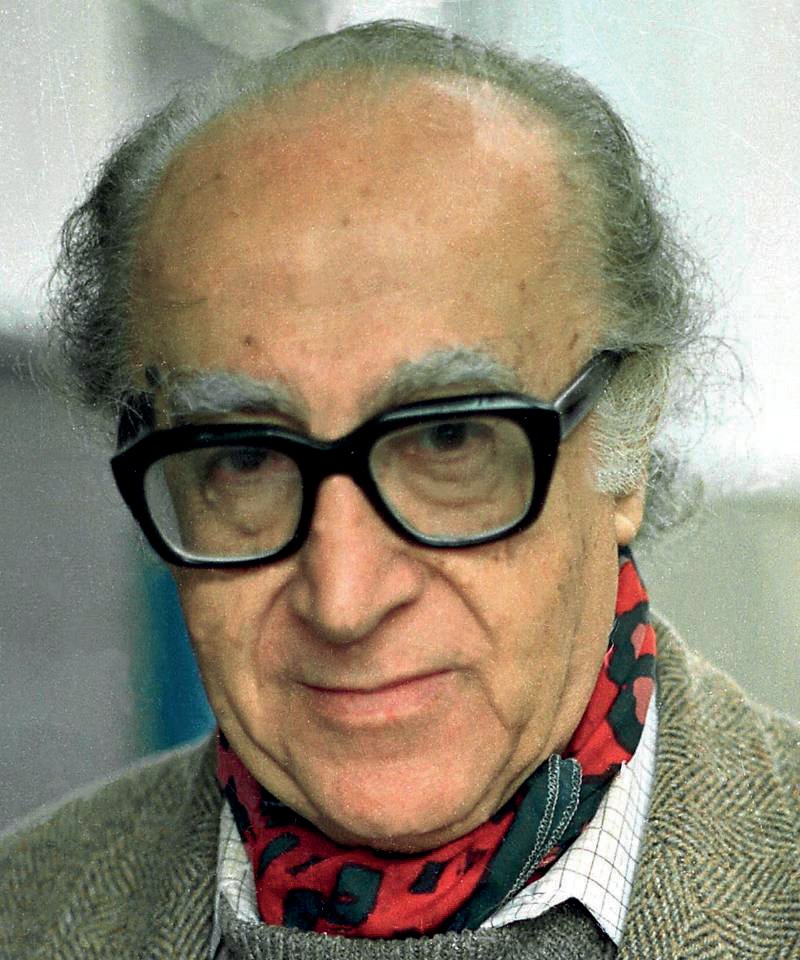
After writing two novels, one of them in English, he attracted attention with his third novel, The Ship. He continued his success with In Search of Walid Masoud. After A World Without Maps, which he co-wrote with the Saudi novelist Abdul Rahman Munif, he also drew attention with The Other Rooms.
The most distinctive feature of his novels is his brilliant style. Almost all of them display extraordinary flexibility of language, abundant energy, a poetic rhythm of their own and great mastery in the choice of words.
In his novels, as in many of his short stories, Jabra lets distinguished intellectuals speak. In The Ship, for example, two fourteen-year-old boys in Jerusalem in the 1930s are able to hold an artistic conversation about a painting by Botticelli.
Born in Acre, Samira Azzam was forced to emigrate to Cyprus in the 1948 war and died there a year before the 1967 war (the Naksa). Azzam drew on a realistic ground in her texts. She was successful in depicting many aspects of human experience, including the experiences of women in Arab culture. She used a precise, brief, concise and clear style, far from melodrama and vulgarity, and constructed her stories skilfully. In her story “Tears for Sale” she reveals the contradiction of a woman who mourns the dead professionally: the woman, who weeps at funerals as her trade, cannot shed a single tear when her only daughter dies.
Ghassan Kanafani entered the literary field in the early 1960s with The Death of Bed No. 12, a collection of seventeen short stories. Although the stories in this book, like those in his three later collections, vary in artistic maturity, many of them are counted among the strongest short stories of modern Arabic literature. His second collection, The Land of Sad Oranges, contains ten stories focusing on Palestinian experiences coloured by tragedy. The triptych “Three Papers from Palestine” deals with the Palestinians’ hard journey into exile. In the collection A World Not Ours, Kanafani shows how sensitive a storyteller he is as a detailed observer of human behaviour. In his fourth collection, On Men and Rifles, he again conveys various Palestinian experiences to the reader.

Kanafani began writing while working as a teacher in Kuwait. In 1959 he returned to Damascus, where his family had lived since 1948, then moved to Beirut, where he became the spokesman of the Popular Front for the Liberation of Palestine. Despite being diabetic, he never stopped writing. With Men in the Sun (1963), All That’s Left to You (1966) and Returning to Haifa (1969) he brought his craft to its highest levels.
Men in the Sun is one of the most important modern classics of Arabic literature. The story deals with the problem of survival faced by three men of different ages and social backgrounds as they try to enter Kuwait. It addresses the irony in the misery that followed the catastrophe of 1948 and the Palestinians’ struggle to survive, and stresses that this tragic experience was similar for everyone. This highly symbolic story placed Kanafani in the front rank of fiction writers in Arabic literature, and in Palestinian literature in particular.
His second novel, All That’s Left to You, is also one of the most brilliant works written in Palestinian and Arabic literature. It can be called an early and original attempt to modernise Arabic literature. Kanafani achieved in the short story and the novel the modernism that the Palestinian Tawfiq Sayigh and the Syrian Muhammad al-Maghut achieved, without being aware of it, in poetry. These writers wrote modern texts at a time when modernity was not yet being spoken of in Arabic literature.
Besides these names there are other important fiction writers from the West Bank, foremost among them Emile Habibi, Sahar Khalifeh and Yahya Yakhlif.
In his story collection Sextet of the Six Days, Emile Habibi deals with the adventure of families, brought together by the occupation after the Naksa (1967), seeking and finding each other after 19 years. His famous novel The Secret Life of Saeed the Pessoptimist was translated into Hebrew and other languages, and studies of it were published in many journals and books in the Arab world and in Israel. The novel takes up twenty years of the lives of Palestinians in Israel and then joins these sections together. Its main character is the foolish, pessimistic Saeed, whose quest for survival under the harsh rule of Israeli occupation recalls that of Švejk in the famous novel by the Czech writer Jaroslav Hašek. Saeed represents another wise fool and comic hero who spies for the State of Israel. But thanks to his foolishness, cowardice and candour he turns into a victim and, failing to accomplish his task fully, reverses his role and supports the Palestinian resistance.
Sahar Khalifeh rediscovers and incorporates into her texts the dialects, vocabulary and thought patterns of the various classes of urban Palestinians, simple workers and intellectuals. She usually chooses her characters from the Nablus region, where she herself lived. She focuses on two main subjects: the Palestinian struggle and the struggle for women’s liberation.
Khalifeh’s best work concerning women is her novel Memoirs of an Unrealistic Woman (1986), in which she explores problems of ambition among women and the restrictions imposed on them. In her novel Sunflower she reveals the close harmony between the political struggle and the feminist struggle.
Yahya Yakhlif was the first Palestinian writer to go genuinely beyond the scope of current Palestinian politics to describe the terrible operations of revenge that oppressive, fundamentalist regimes in Arab countries carry out against those who rebel against them. In Najran Below Zero (1975) he describes a semi-ritual beheading in Najran with a truthfulness and vividness unparalleled in modern Arabic literature.
Another important writer of this period, Ibrahim Nasrallah, is a prolific author who has published many books of poetry and novels. The series of novels he calls The Palestinian Comedy consists of eight independent novels narrating various phases of Palestine. One of them, Time of White Horses, tells the lives of three generations of a family living in a Palestinian village, beginning with the collapse of Ottoman rule and continuing through the British Mandate to the catastrophe of 1948, when the Palestinian Arabs were driven out of former Mandate Palestine. In his latest novel, The Second War of the Dog, Nasrallah skilfully brings a dystopian future into fiction using the techniques of fantasy and science fiction.
The reflection of a state of mind in literature
After the catastrophe of 1948, when the State of Israel was established as a fait accompli, the Palestinians experienced a second trauma in 1967. Exactly 19 years later the catastrophe recurred, which is why it is called the “Naksa” (relapse). The war that began on 5 June 1967 between Israel and its Arab neighbours Egypt, Jordan and Syria lasted six days and ended with Israel’s decisive superiority. At the end of the war Israel occupied Egypt’s Sinai Peninsula, Syria’s Golan Heights and the Palestinian territories of the Gaza Strip and the West Bank. This defeat was the greatest trauma for all Palestinians and Arabs, and its effect continues even today. It is entirely natural that this state of mind was reflected in literature.
In all the regions where Palestinians live – in the occupied territories, in Israel, in the diaspora and in today’s Palestinian Authority – poetry, in parallel with the art of fiction, reached levels it had never reached before, in both quantity and quality.

By the 1970s two main points draw our attention. The first is the great change that Arabic poetry, including Palestinian poetry, underwent in terms of language and imagery. As poets discovered Western poetry, they began to discover the creative veins of pre-Islamic, Umayyad, Abbasid and Andalusian poetry; in discovering the other, they became aware of their own riches. What gave them this opening was above all the journal Shiʿr (Poetry), led by the Syrian poet Adonis.
Resistance poetry, one of the important themes of Palestinian poetry in the 1950s, became the main theme in the 1970s. Yet being wholly preoccupied with resistance inevitably created difficulties at the artistic level. The poets who became famous in these years returned to the stage in the 1980s and managed to free themselves from the earlier negative tendencies. Mahmoud Darwish, Samih al-Qasim, Khairi Mansour, Mourid Barghouti, Ahmad Dahbour, Walid Khazendar, Ghassan Zaqtan, Zakaria Mohammed, Ibrahim Nasrallah and Mohammad al-As’ad are some of them.
Mahmoud Darwish, known not only in Palestine but throughout the Arab world for his resistance poems, addressed Fadwa Tuqan with these lines as he left Palestine in the 1970s:
نحن في حلِّ من التذكار
فالكرمل فينا
وعلى أهدابنا عشب الجليلِ
لا تقولي : ليتنا نركض كالنهر إليها،
لا تقولي!
نحن في لحم بلادي..وَهْيَ فينا!
لم نكن قبلَ حزيرانَ كأفراخ الحمام
ولذا، لم يتفتَّتْ حبنا بين السلاسلْ
نحن يا أُختاه، من عشرين عام
نحن لا نكتب أشعاراً،
ولكنا نقاتل
(We have no need of remembrance:
Carmel is within us,
and on our eyelashes the grass of Galilee.
Do not say: if only we could run to her like the river.
Do not say it!
We are in the flesh of my country… and it is in us.
Before June we were not like fledgling doves,
and so our love did not crumble among the chains.
For twenty years, my sister,
we have not been writing poems —
we have been fighting. — Mahmoud Darwish; translated from the Arabic for this site)
Palestinian poets, including Darwish, turned to “resistance” poems with a strong aesthetic ground. With his book I Love You, I Love You Not, published in Cairo, Darwish began to write harmonious poems close to prose. After this he turned to poems sometimes lyrical, sometimes epic in style. In his late poems he uses the traditional Arabic metres (tafʿila) with a fluent, flexible rhythm and a calmer poetic voice, thus bringing verse and prose closer together. Whatever Mahmoud Darwish’s approach, his poetry shines beyond poetic periods and boundaries. It also reinforces the standing of the Palestinians as a people contributing to global cultural life.
Walid Khazendar uses a fluent style that never breaks away from everyday language, and carefully chosen ambiguous images. Starting from Palestinian identity, he tries to build a universal poetic world. Ghassan Zaqtan carries themes concerning the Palestinian in the street to a universal dimension, while Zakaria Mohammed writes poems in a more immanent, calm, ironic and self-critical tone. Mourid Barghouti too often replaces the loud tone of his early poetry with an ironic breath. Mohammad al-As’ad opens his poetry to the world of metaphor from a broader perspective while preserving his original individual voice, thus adding to Palestinian poetry a highly aesthetic, urban vein despite his village origins.
Samih al-Qasim, who devoted almost all his poetry to the Palestinian cause, lightened its political tone at times and slid into lyricism and humour so as not to repeat himself. Sometimes he tried to complete his lines together with the audience through a kind of improvisation technique. He also used “postmodern” techniques such as collages of poetry, prose and press releases.
The period of betrayal, anger and disappointment
Just as the Nakba and the Naksa form the critical crossroads of Palestinian literature, the Oslo process and the recognition of the Palestinian Authority also became an important crossroads. But this process of recognition did not guarantee the Palestinians’ right of return. The status of Jerusalem was postponed to be determined later, and Israel’s policy of building settlements did not change. Although the Oslo process provided for Israel’s withdrawal from the West Bank and Gaza and for the Palestinians to build their own civil institutions, Israel’s policies of isolation turned the Palestinian lands – the north and south of the West Bank, East Jerusalem and the Gaza Strip – de facto into areas where an “apartheid” regime like that of South Africa was applied.
Although the Oslo process brought the Palestinians some gains, the Palestinian territories were divided into Areas A, B and C, the division was made permanent, and the Jewish settlements in the Palestinian territories became permanent. Israel never approached the “two-state” solution envisaged by the agreement. Edward Said described the Oslo Accords as “a Palestinian Versailles”, recalling the conditions the Allied Powers imposed on Germany after the First World War.
From the Palestinians’ point of view, this period can be summed up by feelings of betrayal, anger, disappointment and despair. These feelings can be seen in the poems of the leading poets of the period, such as Najwan Darwish, Samer Abu Hawwash, Asmaa Azaizeh, Fakhri Rattrout, Asma al-Hajj, Ghayath al-Madhoun, Sultan al-Qaisi and Mazen Maarouf. Written mostly in an ironic, at times neurotic language, these poems make the blatant betrayal and hypocrisy committed once again against the Palestinian question through the Oslo process fully visible. Najwan Darwish’s book of poems Kudüs’ün Kapısında Kelimeler (Words at the Gate of Jerusalem; Ayrıntı Yayınları, 2023), published last month in my translation, is the most concrete proof of this. There are also those who write more inward-looking or existential poems: while Khaled Nasiri turns to more inward poems focusing on his childhood, Mona Zaher and Ali Abu Khattab follow an existentialist line that could be called “avant-garde”.
Among the post-Oslo writers of short stories and novels, the first names that come to mind are Adania Shibli, whose novel Minor Detail has been published in Turkish, Alaa Hlehel, Huzama Habayeb, Ziad Khaddash, Mazen Maarouf, whose book Jokes for the Gunmen has been published in Turkish, Majd Kayyal and Larissa Sansour.

Palestinian literature is of course not limited to those who write in Arabic. In the post-Oslo period we can also speak of the literature of the “Palestinian diaspora” written in languages other than Arabic. We should note, however, that each language environment outside Palestine has its own Palestinian character. Of these writers, Susan Abulhawa writes her novels in English. Susan Muaddi Darraj writes about the difficulties and divisions of Palestinians as well as subjects such as American and Palestinian womanhood and feminism; she even sometimes speaks of Palestine with “hatred” because of the troubles it has brought her. Randa Jarrar is a writer who migrated from the West Bank to Kuwait, from there to Egypt and then to Texas; her novels focus on subjects such as the female body, sexuality and violence, and she does not hide that she is a lesbian. The writer and translator Anton Shammas writes his novels in Hebrew; his Hebrew novel Arabesques (1986) has been translated into nearly ten languages. The novelist and screenwriter Sayed Kashua has written four novels in Hebrew.
When the poet Yahya Hassan died in 2020 at the age of twenty-four, he was among the mainstream writers of Denmark. It is interesting that, although Wikipedia has his biography in many languages including Turkish, there is none in Arabic. Nathalie Handal, born in Haiti, has travelled to many parts of the world; she has published eight books of poetry and has also written many plays and essays. Mai Masri, Annemarie Jacir, Maha Haj, Maysaloun Hamoud, Cherien Dabis and Suha Arraf are just a few of those who bring Palestine into their fiction in languages other than Arabic. Interestingly, apart from a few of them, the Arab world too is not yet aware of these writers in terms of translation.
As this study shows, a comprehensive survey of Palestinian literature cannot fit into a few pages. A more detailed study requires following not only Arabic but also languages such as Hebrew, English, Spanish, Danish and Italian.
Palestinian writers and works translated into Turkish
Let us turn to Palestinian literature in Turkish. Two original books stand out on this subject. The first is Ali Çakmak’s Düşmanlıklar Zamanı: Gassan Kanafani ve Filistin Direniş Edebiyatı (Time of Enmities: Ghassan Kanafani and Palestinian Resistance Literature; Zoom Kitap, 2020), which analyses Kanafani’s work as a novelist and short story writer with quotations from his texts. The second is Peren Birsaygılı Mut’s biographical compilation Zeytin Ağaçları Arasında: Filistin Edebiyatından Portreler (Among the Olive Trees: Portraits from Palestinian Literature; Usta Kitap, 2018), which, after the biographies of Fadwa Tuqan, Ghassan Kanafani, Mahmoud Darwish, Samih al-Qasim and Naji al-Ali, also includes sample texts by Palestinian writers.
As for translations, the list of works by Palestinian poets translated directly from Arabic into Turkish is as follows:
| Author/Poet | Title | Translator | Publisher | Year |
| Necvan Derviş | Kudüs’ün Kapısında Kelimeler | Mehmet Hakkı Suçin | Ayrıntı | 2023 |
| Mahmud Derviş | Badem Çiçeği Gibi yahut Daha Ötesi | Mehmet Hakkı Suçin | Everest | 2020 |
| Mahmud Derviş | Atı Neden Yalnız Bıraktın | Mehmet Hakkı Suçin | Ayrıntı | 2017 |
| Mahmud Derviş | Bu Şiirin Bitmesini İstemiyorum | Mehmet Hakkı Suçin | Yapı Kredi | 2016 |
| Mahmud Derviş | Mural | Mehmet Hakkı Suçin | Kırmızı | 2015 |
| Mahmud Derviş | Biz Kaybettik Aşk da Kazanmadı | Lütfullah Göktaş | Kitabevi | 2008 |
Translations into Turkish of fiction by Palestinian writers are as follows:
| Author | Eser Adı | Çeviren | Yayınevi | Year | Genre |
| Gassan Kanafani | Güneşteki Adamlar | Mehmet Hakkı Suçin | Metis | 2023 | Novel |
| Adania Shibli | Küçük Bir Ayrıntı | Mehmet Hakkı Suçin | Can | 2021 | Novel |
| Gassan Kanafani | Bizim Olmayan Âlem | Ökkeş Hengil | Loras | 2023 | Short stories |
| Gassan Kanafani | On İki Numaralı Yatağın Ölümü | Murat Göçer | Loras | 2022 | Short stories |
| Gassan Kanafani | Hüzünlü Portakallar Yurdu | Muhammed Ali Söylemez | Loras | 2022 | Short stories |
| Mazen Maruf | Silahlı Adamlar İçin Fıkralar | Mustafa İsmail Dönmez | Yeni İnsan | 2018 | Short stories |
| Faruk Vadi | Saudade/ Ceylan Uçurumu | Abdussamed Yeşildağ | Farabi | 2022 | Novel |
| Mahmud Derviş | Gazze İçin Sessizlik: Alışılagelmiş Hüznün Günlüğü | Hakan Özkan | Özgür | 2009 | Memoir |
Translations from Palestinian writers who write in English:
| Author | Title | Translator | Publisher | Year | Genre |
| Suzan Abulhawa | Sevgisiz Dünyaya Karşı | Şafak Tahmaz | The Kitap | 2022 | Novel |
| Suzan Abulhawa | Yüreğimin Senden Tarafı | Handan Ünlü Haktanır | Koridor | 2016 | Novel |
| Suzan Abulhawa | Filistin Sabahları | Berrak Göçer | Everest | 2010 | Novel |
Translations into Turkish via English as an intermediary language are as follows:
| İbrahim Nasrallah | Karanlığın İçinde Filistin’in Siyah Güneşi | Arzu Nalbantoğlu | Pupa | 2009 | Novel |
| Mourid Bargouti | Şairin Filistini | A. Melis Hafez | Klasik | 2004 | Novel |
Besides these books, here are the names of some of the Palestinian writers whose poems and stories I have published in journals and anthologies in past years: Fadwa Tuqan, Samih al-Qasim, Mahmoud Darwish, Hanan Awwad, Musa Hawamdeh, Mourid Barghouti, Ghassan Zaqtan, Samer Abu Hawwash, Najwan Darwish, Mona Zaher, Fakhri Rattrout, Ali Abu Khattab, Asmaa Azaizeh, Ghayath al-Madhoun, Sultan al-Qaisi, Asma al-Hajj, Riyad Baydas, Ghassan Kanafani, Yahya Yakhlif, Mahmoud Shukair, Ziad Khaddash, Mazen Maarouf. In addition, in the chapter “The Influence of Nâzım Hikmet on Arab Poetry” in Turkish Literature as World Literature, edited by Burcu Alkan and Çimen Günay-Erkol, I discuss how Arab poets, Palestinian writers above all, were influenced by Nâzım Hikmet.

In short, it is entirely natural that the literature of the Palestinian people – who have gone through very painful processes and suffered enormous traumas over the past hundred years and, as we all know, are once again living through very hard times – should have been shaped under the conditions described in this essay, and should determine its place in and its position towards world literature by passing through these conditions. Although this has resulted in Palestinian literature being shaped predominantly as a literature of resistance, it has not prevented it from growing, enriching itself and gaining strength simultaneously with world literature. On the contrary, it has made it masterful in understanding and expressing the human being and all that is human. Reading Palestinian literature from past to present from this perspective will open entirely new doors for both readers and writers to understand the region and its people.
First published in: Yeni E Culture, Arts and Literature Magazine, no. 78 (February–March 2024), special issue “The Cultural Resistance of Palestine”, pp. 31–43.

Read the essay as published in the magazine (PDF, in Turkish) →
Translated from the Turkish for this site.